MSU, ZPSC Champion Knowledge Partnerships to Transform Public Service Delivery
October 12, 2026 2026-10-12 10:02MSU, ZPSC Champion Knowledge Partnerships to Transform Public Service Delivery
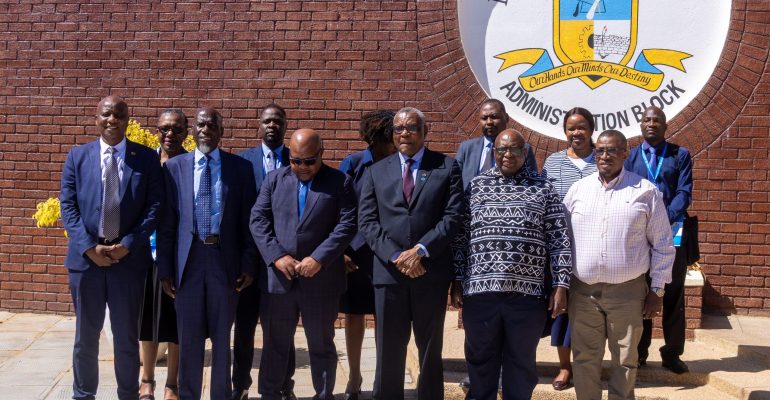
Midlands State University (MSU), through its Faculty of Social Sciences, partnered with the Zimbabwe Public Service Commission (ZPSC) on a public lecture to explore ways of strengthening knowledge partnerships between academia and government for the improvement of public service delivery at the Gweru Main Campus on 9 October 2026.
Held under the theme “From Knowledge to Impact: Universities as Catalysts for Public Sector Transformation”, the public lecture brought together universities and public service representatives, academics and students to deliberate on the role of universities in translating research and academic knowledge into practical innovations, public policies and workforce capabilities.
In his opening remarks, University Registrar Dr. T. Zishiri set the tone for discussions on strengthening collaboration between higher education institutions and government highlighting that, “The future belongs to universities that create, innovate and collaborate.”
Under the Education 5.0 philosophy, Midlands State University has evolved beyond its teaching and learning to nurture entrepreneurial, innovative and solution-oriented graduates equipped to address real-world challenges and contribute to national development.
Delivering the welcome remarks, MSU Vice Chancellor Professor V. N. Muzvidziwa reaffirmed the University’s commitment to building lasting partnerships with government and the public sector, emphasising that its contribution to national development extends beyond producing skilled graduates to providing research, expertise and innovative solutions to public sector challenges.
“Midlands State University remains committed to building enduring partnerships with government and the public sector. We therefore seek to be not only a provider of human capital, but also a trusted knowledge partner to the government, contributing evidence, expertise, research, innovation and new ideas to the national development agenda,” Professor Muzvidziwa said.
Complementing the Vice Chancellor’s address, ZPSC Chairperson Dr. V. Hungwe commended MSU for contributing to national development through research, innovation and interdisciplinary scholarship that inform public policymaking and address the practical challenges facing the public sector.
“There are institutions whose significance extends far beyond the boundaries of their campuses. Midlands State University is one such institution,” highlighted Dr. Hungwe, describing MSU as a hub of interdisciplinary scholarship with a distinctive mandate to contribute to the country’s development.
He stressed that universities must not operate as centres of abstract knowledge detached from governance, public sector modernisation and the realities of service delivery, but should contribute actively to evidence-based policymaking, institutional innovation and inclusive, sustainable social and economic growth.
Cognisant of the existing gap between academia and the public sector, Midlands State University established the Centre for Public Policy and Devolution in 2020 to strengthen the nexus between academic research and public policymaking through actionable insights and multi-stakeholder engagement aimed at addressing national development priorities.
The public lecture also featured a question-and-answer session, which provided an engaging platform for students, academics and public service representatives to interact with the speakers, exchange ideas and seek clarity on issues raised during the presentations.
The session further enabled participants to explore how stronger partnerships between academia and government could bridge the gap between research and practice, strengthen public sector capacity and improve service delivery.
Delivering the vote of thanks, Executive Dean of the Faculty of Social Sciences Professor T. Marambanyika reaffirmed MSU’s commitment to advancing Education 5.0 and ensuring that teaching and research translate into innovation, human capital development and practical solutions to national challenges.
As Zimbabwe advances towards a knowledge-based economy, MSU remains committed to building enduring partnerships that connect academic knowledge with national priorities and contribute to the transformation of public service delivery.